
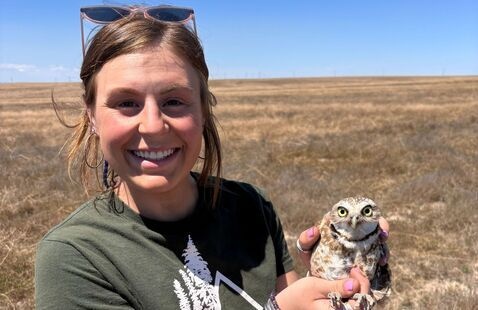
About this Event
2360 W. University Drive, Boise, ID 83725
Title: Genetic Monitoring of a Burrowing Owl (Athene cunicularia hypugaea) Population in Southwestern Idaho Reveals Stable Genetic Diversity and No Sign of Inbreeding Across Nearly Three Decades
Program: Raptor Biology MS
Committee Chair: Stephen Novak
Committee: Stephen Novak, James Belthoff, James Smith
Abstract: Rapid global environmental change has caused drastic population declines, the extinction of species, and a reduction in biological diversity around the globe. One critical component of global biodiversity is the level of genetic diversity within populations, which influences the ability of populations to respond to changing conditions. This study offers unique insights into the genetics of a primarily migratory breeding population of Burrowing Owls (Athene cunicularia subsp. hypugaea) located in Southwestern Idaho, USA, through a genetic monitoring approach. The study included a total of 54 individuals sampled across five time periods (1997, 2002, 2007, 2013, and 2025). A 5,173 neutral Single Nucleotide Polymorphism (SNP) panel was assembled using Restriction site-Associated DNA sequencing (RADseq) methods to estimate levels of genetic diversity and genetic differentiation of this population, and assess whether genetic diversity has changed across 28 years. Multiple structure analyses (PERMANOVA, PCA, DAPC, STRUCTURE, and AMOVA) consistently showed an absence of temporally-based genetic structure. AMOVA detected no measurable genetic differentiation among sampling years, with essentially all genetic variation occurring “within individuals.” Pairwise Weir–Cockerham FST values remained close to zero (-0.0027 to 0.0015), supporting the conclusion that no temporal genetic structure has occurred. FIS values near zero, and slightly negative (ranging from -0.0128 to -0.0026), indicated that levels of inbreeding did not change over time. Other genetic diversity parameters (H?, H?, nucleotide diversity (p)) remained stable across all sampling years. These results indicate that individual owls sampled across the five time intervals represent a subsample of a larger, panmictic, and genetically diverse Snake River Plains population of Burrowing Owls, suggesting high connectivity and gene flow among individuals in this region. The study’s findings provide evidence that this breeding population has maintained stable genome-wide neutral genetic diversity across nearly three decades despite ongoing habitat change. This research also establishes a valuable genetic baseline for future genetic monitoring and conservation of this population, and other populations of Burrowing Owls.
Event Details
Dial-In Information
You must register for this Zoom meeting ahead of time.
Meeting ID: 919 7684 4112
Passcode: 020519